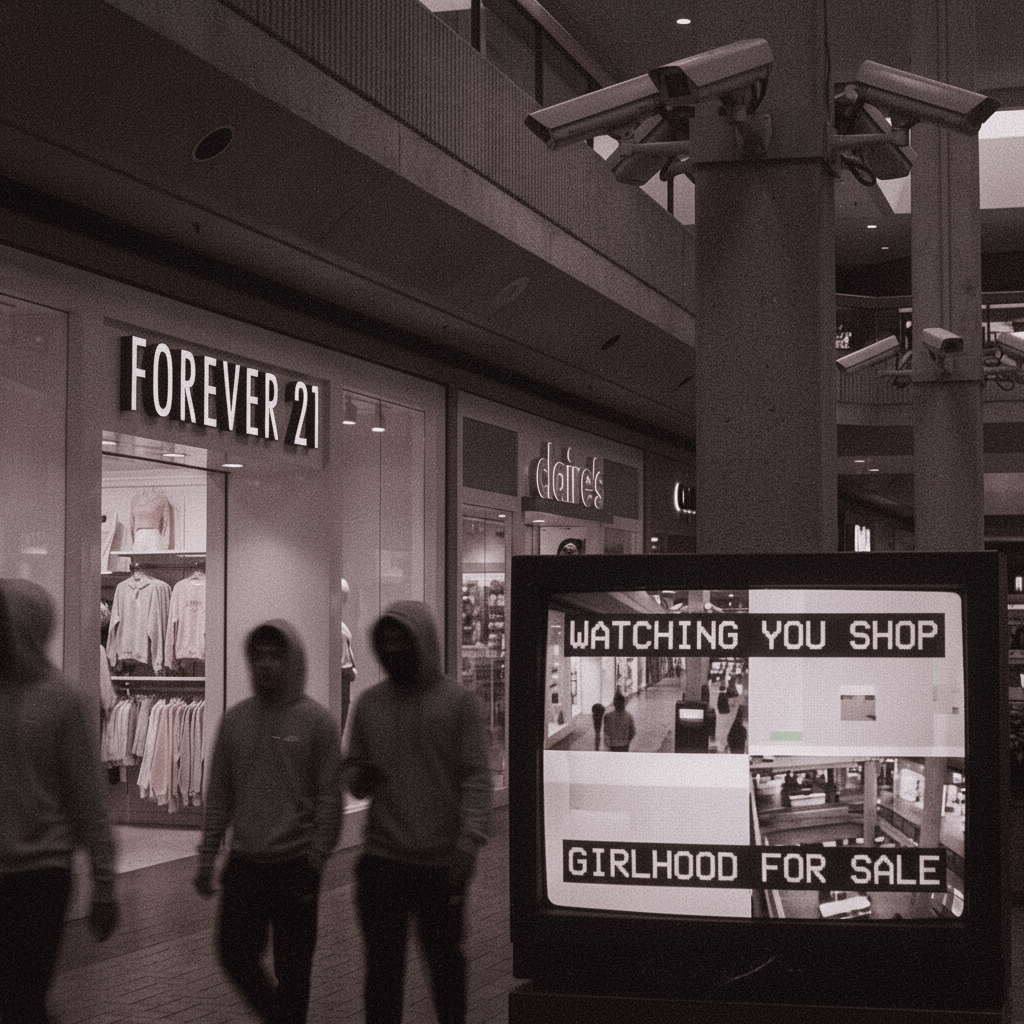
The strangest part wasn’t the shock.
It was the recognition.
When the names resurfaced and the files circulated again, I didn’t feel blindsided. I felt something closer to confirmation. Not of every rumor. Not of every whisper. But of the pattern.
Power protects itself.
Wealth negotiates consequences.
Girls are collateral.
I’ve been writing about girlhood all year — about longing, about complicity, about the way we laughed at jokes we didn’t yet have language to reject. This feels like the structural version of that story.
Millennial girlhood didn’t feel dangerous in a cinematic way. It felt curated. Designed. Branded.
We wore Victoria’s Secret PINK across our chests before we understood what it meant to brand ourselves. We begged for Abercrombie bags with shirtless torsos on them. We shopped at Limited Too — pastel, glittered girlhood packaged for purchase. We absorbed the rules early: be thin, be hot, be effortless, don’t be difficult.
It felt like culture.
But culture has owners.
Victoria’s Secret and Limited Too were owned by L Brands, led for decades by Leslie Wexner. Wexner’s documented financial and personal relationship with Jeffrey Epstein is part of the public record. Epstein managed his finances. He held power of attorney. He moved in the same elite networks where modeling pipelines and access to young women intersected with money and influence.
Abercrombie built an empire on hyper-sexualized youth marketing under leadership later associated with serious exploitation allegations of its own. Again: documented reporting, not internet mythology.
The point isn’t to spiral into conspiracy. It’s to stop pretending the aesthetic machine we grew up inside was detached from power.
We were not dramatic for feeling watched.
We were not shallow for wanting to belong.
We were not crazy for sensing that desirability was currency.
It was.
When youth is profitable, youth will be commodified.
When wealth is insulated, wealth negotiates.
When reputation is valuable, institutions defend it.
Systems don’t need secret meetings to behave predictably. They only need aligned incentives.
And those incentives didn’t disappear when we left the mall.
They hardened into policy.
Policy is culture made enforceable.
When childcare costs rival college tuition, care becomes a private burden.
When reproductive healthcare becomes geographically fragile or politically negotiable, options shrink.
When economic power quietly shapes political outcomes, public leverage thins.
When instability grows and safety nets weaken, exits narrow.
Disenfranchisement is rarely dramatic. It accumulates.
It accumulates in unpaid labor.
In maternal burnout.
In underfunded foster systems.
In women doing impossible math alone.
And here is where the loop closes.
When care erodes and autonomy narrows, real people become exposed.
Young women with no financial exit.
Single mothers stretched past the breaking point.
Pregnant teenagers facing shrinking options.
Children moving through overburdened foster systems.
Kids without stable childcare while parents work survival jobs.
When options shrink, leverage shifts.
Economic pressure makes dependence more likely.
Dependence increases vulnerability.
Vulnerability widens power imbalances.
That instability generates profit — sometimes quietly, sometimes violently.
Profit concentrates power.
Power shapes policy.
And policy that protects capital over care recreates the instability that narrowed options in the first place.
The system feeds itself.
Not because everyone is in on it.
But because the incentives reinforce each other.
We are living in a moment where social services thin, reproductive rights narrow in parts of the country, childcare costs climb faster than wages, and public trust erodes.
At the same time, curated online narratives romanticizing “traditional wives” trend across platforms — economic and political dependence reframed as empowerment.
I don’t fault women for choosing home.
I question a culture that narrows exit routes while aestheticizing dependence.
If you start noticing how often the story comes back to shrinking options for women, you can’t unsee it.
The instinct to burn it all down makes emotional sense. But collapse rarely protects the vulnerable. It protects whoever consolidates fastest.
What feels sharper to me now isn’t destruction. It’s recognition.
The recognition that we grew up inside an architecture where youth was currency and power insulated itself.
The recognition that instability is not always accidental — it is often useful.
The recognition that economic and political dependence are not just personal circumstances. They are structural outcomes.
And once you see the structure, you can’t unsee it.
I don’t want inversion.
I don’t want women replacing men at the top of the same pyramid.
I want power that faces consequences.
Systems that don’t flinch at wealth.
Care treated as infrastructure instead of sacrifice.
Not because it sounds moral.
Because it sounds stable.
We were shaped inside a system that monetized girlhood and insulated power.
We see it now.
We are raising children inside it.
That changes what we tolerate.
 Daniella M. Aponte
Leave a comment