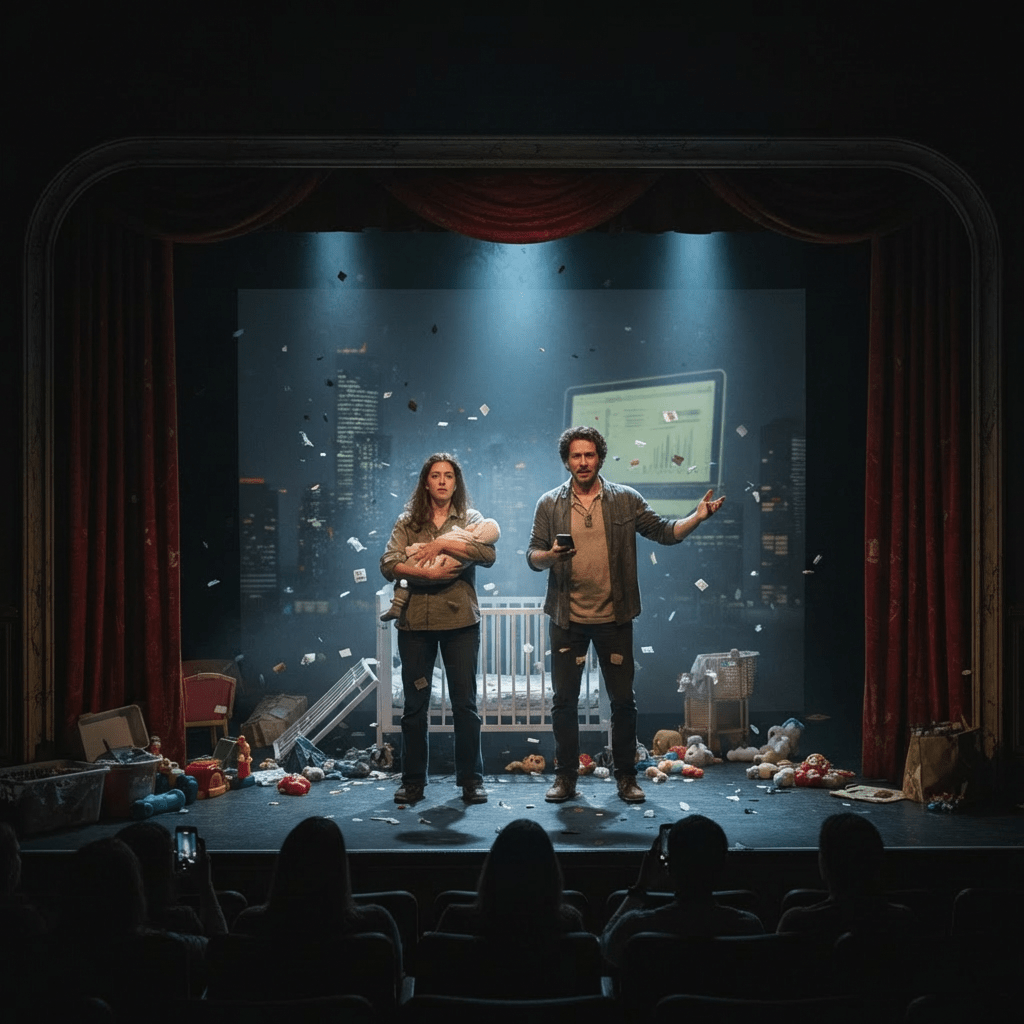
On millennial parenting culture, the involved father, and why our children’s movies keep making us cry
Something happens in the dark of a children’s movie when you’re a millennial parent.
Not at the obvious parts. Not at the death or the score swelling. At the smaller moments. A parent staying still when everything in them wants to reach out. A child walking toward something the parent can’t follow. The specific ache of loving someone you cannot keep.
I had it watching The Wild Robot. I had it watching Ultraman: Rising. I have it constantly, apparently, at animated movies, which tells me something is happening in these films that isn’t really for the kids.
Millennials didn’t just become parents. We became the first generation to parent as a public identity.
Before a millennial’s child takes their first steps, there’s often already a caption drafted. Pregnancy announcements are staged. Cake smash photos are scheduled. The milestone exists, and then almost immediately, the post about the milestone exists. According to YPulse, a quarter of millennial parents announced their pregnancies on social media. Thirty percent have staged photos specifically to post. Fifteen percent have created entire social media accounts dedicated to their child.
The child is documented before they have opinions about being documented.
This generation also spends more time on social media after having kids than before — averaging over four hours a day, more than our non-parent peers, according to YPulse research. We are, somehow, more online once we have children. Absorbing more. Comparing more. Broadcasting more.
And the momfluencer industry — which has grown over 100 percent in five years according to a 2024 research review — isn’t a niche anymore. It’s a mirror. Mothers, and increasingly fathers, monetizing the daily, emotional, chaotic business of raising children. Making the parenting journey the content. Building audiences around the weight of it.
That’s not a criticism. It’s a pattern. And patterns show up everywhere — including in what we greenlight, stream, and cry at in movie theaters.
Here’s the thing about Ultraman: Rising that doesn’t get said enough.
Ken Sato isn’t a mother figure. He’s not a maternal stand-in. He’s a man — an overwhelmed, unprepared, kind of selfish man — who gets handed an infant kaiju and has to figure out, in real time, how to be someone’s father. The film doesn’t soften this. It lets him be bad at it. It lets the baby be inconvenient. It lets the love arrive after the obligation, not before.
That is a portrait of fatherhood we have almost never seen in children’s animation. And it’s not accidental that it’s appearing now.
According to Pew Research Center, millennial dads have tripled the time they spend on childcare compared to fathers in 1965. In 1982, 43 percent of dads admitted they’d never changed a diaper. Today, that number is down to 3 percent. And perhaps most tellingly, 57 percent of millennial dads say that fatherhood is a core part of their identity — only one percentage point behind mothers, per the same Pew data.
One point.
That gap is essentially gone. And Ultraman: Rising is the first children’s animated film I can think of that shows a father earning that identity in real time — not inheriting it, not performing it, but building it through presence and failure and trying again. Ken doesn’t become a great father because the plot requires it. He becomes one because he keeps showing up when it would be easier not to.
That’s the millennial dad. Not perfect. Genuinely there.
The older template was simple: parents are background. Adventure begins when they leave the room.
Simba’s father dies in act one. Ariel’s father is the obstacle. Cinderella’s parents are gone before we meet her. The story belonged to the child. The parent was either the system to escape or the ghost to avenge.
The Wild Robot and Ultraman: Rising do something structurally new: they put the parent at the center, and they make the parent’s emotional arc the engine of the film. Not what the child learns. What the parent learns. Roz doesn’t just raise Brightbill — we watch her figure out how. We sit inside her uncertainty. Her failures. Her recalibrations. The film is not really about Brightbill learning to fly. It’s about Roz learning to let him go.
This maps almost exactly onto the emotional frequency of a generation currently spending four-plus hours a day on social media, posting through the weight of parenting, building audiences out of their own becoming.
We were shaped by a culture that told us our inner lives were worth narrating. Our feelings were valid content. Our growth was the story. Then we had children inside that belief system. And now we make films that reflect it back.
Here’s where I want to slow down.
Because there’s a real difference between humanizing parents — showing that caregiving is learned, effortful, emotionally honest — and centering them. Between this is hard and real and making the parent’s growth journey the main event.
In The Wild Robot, Brightbill’s interiority stays somewhat opaque. We understand Roz. We live inside her experience. Brightbill flies into a future the film doesn’t show us. The camera stays with her.
That’s a choice. It’s also the choice millennial parenting culture keeps making. The child is beloved and visible and documented — but the story being told is almost always the parent’s. Look at what I’m building. Look at what this costs me. Look at who I’m becoming through this.
According to research from Lurie Children’s Hospital, 85 percent of millennial parents believe social media creates unrealistic parenting expectations. And yet we keep producing it. Keep consuming it. Keep building identities around being the parent who knows it’s hard.
There is a version of “I’m being honest about parenting” that is still, fundamentally, about the parent’s relationship with their own image.
What does a child absorb when the culture around them — the films, the TikToks, the Instagram grids, the whole emotional infrastructure of their early life — keeps returning to the same theme: that raising them is a meaningful, costly, identity-forming journey for the person doing it?
Maybe: they matter. Their existence has weight. Love is chosen, not just given.
Maybe also: they are in someone’s story. Their childhood is content. Their parent is the protagonist, and they are the reason.
These are not the same lesson.
The 90s gave children parents who were absent so kids could be the heroes of their own story.
We’ve given our children parents who are present, trying, emotionally literate, and narrating the whole thing.
Whether that feels like love to a child, or quietly like weight — I don’t know yet. I’m still in it. Still watching the films. Still crying in the dark at the wrong parts.
Still trying to figure out if I’m raising my kid, or telling a story about raising my kid.
Maybe both. Maybe that’s the most honest thing I can say about this generation.
Sources available on request
 Daniella M. Aponte
Leave a comment